It's recommended that children consult with an orthodontist by age 7. Parents whose children have visibly crooked teeth usually will take care of this, but what about the kids whose teeth look straight? Do they still need to see an orthodontist?
The answer is a definitive YES because your child may have dental issues that aren't readily visible. Those dental issues will likely get worse over time, so the earlier they're caught and treated, the better it is for your child. This is why your child needs an orthodontic evaluation at an early age.
Woodhill Dental Specialties offers pediatric dentistry and orthodontics all in one office, which can make such consultations easier for you and your child. It may be that your child needs nothing. It may be that your child has dental issues you can't see, such as a narrow palate or a crossbite in the back of the mouth.
Whatever the issue, Woodhill Dental Specialties can find it — however subtle — and offer solutions to improve your child's oral health.
Does my child need an orthodontist if their teeth are straight? Yes, they do. There is more to a "bad bite" than just crooked teeth.
Overbite, underbite, crossbite, gapped teeth, and an open bite can all be problems that need to be fixed with braces or clear aligners. Some of these are easier to spot than others, especially early on.
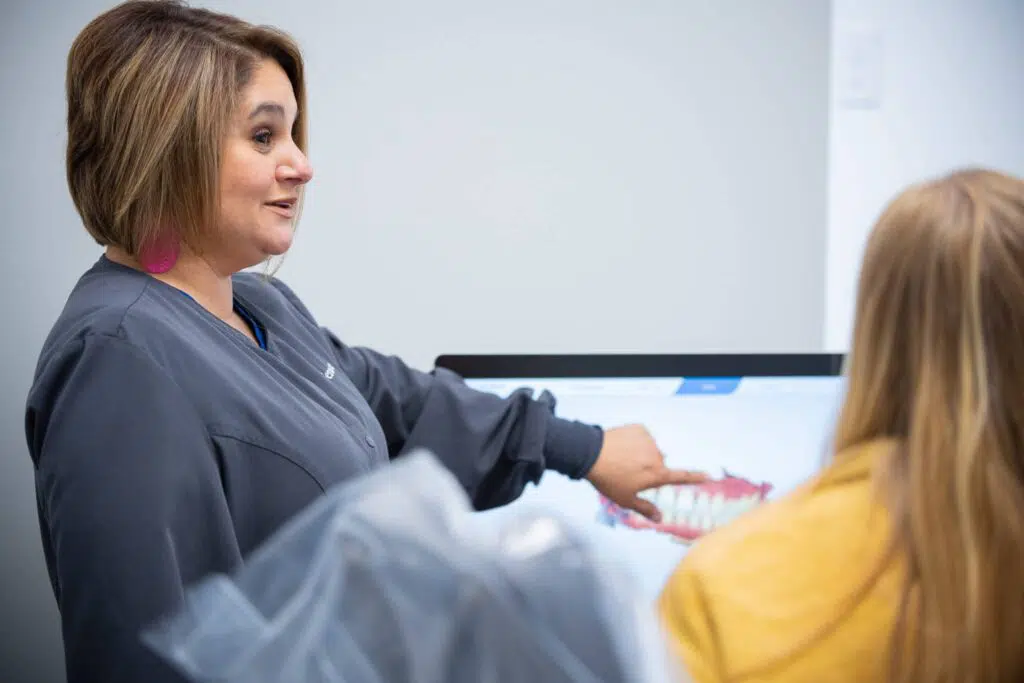
We not only look at what their teeth look like now, but what the teeth that haven't erupted look like. Those teeth could cause others to shift when they erupt. We do this using digital imaging and dental x-rays, along with a full visual examination.
We look at how the teeth meet when the mouth is closed. This determines whether a bite is good or bad. Misaligned teeth can lead to jaw pain, excessive tooth wear, jaw fatigue, headaches, neck aches, and digestive problems, since food that isn't properly ground and chewed is harder on the digestive system once it reaches the stomach.
We also look at jaw development. Is the jaw too narrow for all of the permanent teeth to emerge? Are the permanent teeth developing properly? Will the wisdom teeth cause issues once they come in?
There is a lot to consider, and the sooner it's diagnosed and dealt with, the better for your child and your wallet.
What do we mean by "crossbite, overbite," and "underbite?" Some of these terms are easy to spot, while others are more difficult.
Overbite — the upper front teeth are forward of the lower teeth.
Underbite — the lower front teeth are forward of the upper teeth.
Crossbite — the upper teeth sit inside the lower teeth. It may be one tooth or several, and often it involves the back molars.
Open bite — the upper front teeth are flared outward and well forward of the lower teeth.
Gap teeth — the teeth have a gap between them rather than sitting flush side by side.
Crowded teeth — the teeth don't have enough room to sit flush side by side, so they come in twisted, in front of or behind the neighboring teeth.
We also look at the "dental arch," which is the shape of the teeth arch in the jaw. Is the arch wide enough for all of the permanent teeth to erupt? Do we need to widen that arch with orthodontic appliances, such as a palate expander?
These are some of the things we look for when evaluating your child's oral health, and you can learn more about how we treat each of these bite issues here.
Why is it so important to have your child evaluated by age 7? At that age, all of the baby teeth are in, and the permanent teeth are starting to emerge. Most of the adult teeth (minus the wisdom teeth, or third molars) are developed in the jaw, so we can evaluate if they've developed correctly and are lined up to erupt properly.
Your child's jaw is still developing at that age, so we can use orthodontic appliances to guide the development if it's off track. It's easier to move their teeth and jaws while they are still developing and not fully hardened.
Some orthodontic issues are caused by bad habits, and stopping those habits early can minimize the damage done. This includes thumbsucking, tongue thrusting, and pacifier use. We have orthodontic appliances that can stop these habits and start correcting the problems they cause.
The harder it is to readjust your child's teeth and jaws, the longer it will take, and the more costly it will be. So it's beneficial to you and your child to start early.
What should you expect when your child has their first orthodontic evaluation? We will start with digital imaging and dental x-rays to get a clear picture of your child's mouth, teeth, and jaws. We will also conduct a visual inspection to identify any issues.
We'll take all that information and evaluate whether your child needs any orthodontic treatment. We'll then lay out a plan for your child's orthodontic treatment if any is needed. If there doesn't, we'll let you know that, too. We'll never insist on orthodontic treatment your child doesn't need.
Children evaluated to be good candidates for two-phase orthodontic treatment can start as early as 9-10 years of age. We use orthodontic appliances to prepare their mouths for braces or clear aligners later, usually around ages 11-13.
It's very rare for a child to get braces the first day. There needs to be extenuating circumstances. Most of the time, we schedule braces for later.
Placing braces usually takes 1-2 hours. We clean the teeth, place the brackets, ensure the bonding agent dries and adheres properly, and then attach the archwire. We'll also talk to your child about caring for their braces, including what they can and cannot eat, how best to clean them, and other things they need to know for successful treatment.
Yes, because looks can be deceiving, and your child's teeth may not be as straight as you think. You need a professional orthodontist to properly evaluate their teeth.
Just because teeth aren't crooked doesn't mean they don't need orthodontic treatment. There may be more than you aren't seeing, which is why your child needs an orthodontic evaluation. Your pediatric dentist may recommend that your child see an orthodontist, too, if they spot potential problems.
Woodhill Dental Specialties offers both pediatric dentistry and orthodontics so that your child can feel comfortable with their oral health treatment throughout their childhood. Schedule an appointment with us if you need orthodontic or pediatric dental care in Dallas, TX, or Rockwall, TX.
 This site’s strategy, design, photo & video were created by the marginally-above-average folks @ Clear Partnering Group.